
What is GPT-5? OpenAI’s PhD-Level AI Explained






What is GPT-5? A Deep Dive into OpenAI’s Next-Generation AI
On August 7, 2025, OpenAI officially launched GPT-5, its much-anticipated next-generation artificial intelligence. The release signals a monumental leap in AI capabilities, with the company heralding it as its “smartest, fastest, most useful model yet.” This new iteration moves beyond the “college student” aptitude of its predecessor, GPT-4, to what is being described as a “PhD-level expert.” At its core, GPT-5 is not just an upgrade; it’s a paradigm shift, defined by advanced reasoning, comprehensive multimodal understanding, and an innovative “unified system” architecture designed to redefine human-computer interaction.
At DigitalOriginTech, our analysis confirms that this launch is more than an incremental update—it represents a fundamental rethinking of how AI models operate. By integrating multiple specialized functions into one seamless experience, OpenAI is setting a new standard for what users and developers can expect from an AI collaborator.
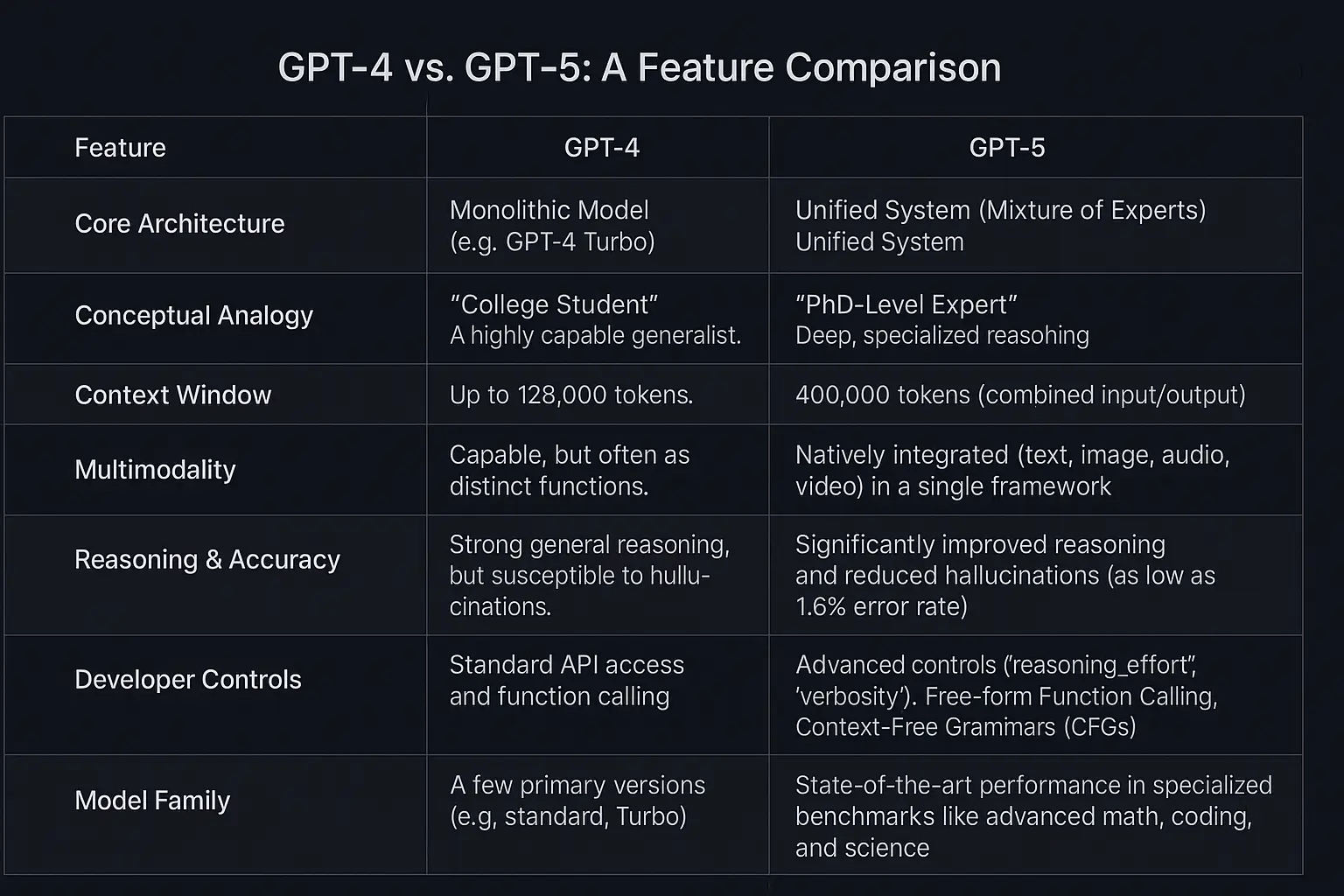
Table of Contents
The Dawn of a New AI Era: What is GPT-5?
GPT-5 is OpenAI’s latest flagship AI system, succeeding the entire family of GPT-4 models. It introduces a significant architectural evolution and a substantial boost in intelligence across a wide array of tasks, including coding, mathematics, creative writing, and visual perception.
From College Student to PhD: The Leap in Intelligence
The central promise of GPT-5 is a dramatic enhancement in reasoning and problem-solving. While GPT-4 was a highly capable generalist, GPT-5 is engineered for specialized, expert-level performance. This leap is most evident in its ability to handle complex, multi-step problems that require deep domain knowledge and logical deduction. The model has demonstrated state-of-the-art performance on difficult academic benchmarks, including those at the PhD level in science and mathematics, underscoring its advanced cognitive abilities.
More Than a Model: A Unified, Intelligent System
Perhaps the most significant innovation is the move away from a collection of distinct models to a single, unified system. This new architecture, widely believed to be a “Mixture of Experts” (MoE) model, functions like a highly efficient team of specialists. An intelligent “gating network” or router instantly analyzes a user’s prompt and dynamically decides which internal expert, or combination of experts, is best suited for the task.
This system can route simple queries to a fast, lightweight model for a quick response, while more complex problems trigger a “deeper reasoning model” that dedicates more time and computational power to deliver a thorough, accurate answer. This eliminates the need for users to manually select different models, creating a seamless, intuitive, and highly efficient user experience.
Unpacking the Groundbreaking Features of GPT-5
GPT-5 introduces a suite of powerful new features and significant improvements that expand its utility for both general users and specialized professionals.
True Multimodality: Processing Text, Images, Audio, and Video
GPT-5 fully integrates text, image, audio, and video processing into a single, cohesive framework. This allows it to understand and reason across different data types simultaneously. For example, it can analyze a video, transcribe the audio, interpret the visual action, and answer complex questions about the content in a single interaction. This native multimodal capability sets a new benchmark for AI, moving beyond simple data processing to genuine cross-modal understanding.
The Expansive 400,000-Token Context Window
A major technical advancement is GPT-5’s massive context window, which supports a combined input and output length of 400,000 tokens. This allows the model to ingest and analyze extremely large documents—equivalent to a full-length book—and maintain coherence over lengthy, complex conversations. For businesses, this means GPT-5 can analyze an entire annual report to generate an insights brief; for developers, it means debugging an entire codebase in one session. This expanded memory significantly enhances its accuracy and reduces the likelihood of hallucinations in long-context tasks.
A Coder’s New Best Friend: Advanced Developer Tools
GPT-5 is positioned as an indispensable coding assistant, capable of generating complex user interfaces from minimal prompts and performing sophisticated debugging on large repositories. It introduces new API parameters like reasoning effort and verbosity to give developers finer control over the model’s output. Key developer-centric features include:
-
Minimal Reasoning: A setting for faster, more cost-effective responses on simple tasks.
-
Verbosity Control: Options for low, medium, or high detail in responses, tailoring the output to the specific need.
-
Free-form Function Calling: Enhanced ability to interact with external tools and APIs, making it more flexible for complex automations.
-
Context-Free Grammars (CFGs): The ability to constrain the model’s output to a specific format, such as JSON, ensuring reliable and structured data for applications.
Enhanced Reasoning and a Commitment to Accuracy
A primary focus for OpenAI has been reducing factual inaccuracies, or “hallucinations.” GPT-5 demonstrates a dramatic improvement in this area, with error rates on critical factual tasks dropping by as much as 80%. In sensitive fields like medicine, error rates on difficult benchmarks have fallen to as low as 1.6%. This increased reliability, combined with its advanced reasoning, makes GPT-5 a more trustworthy tool for professional and academic research.
A Tailored AI for Every Need: The GPT-5 Family of Models
Recognizing that different tasks have different requirements, OpenAI has released a family of GPT-5 models optimized for a range of applications.
-
GPT-5: The flagship model, providing the full spectrum of state-of-the-art capabilities.
-
GPT-5 Pro: An enhanced version with extended and parallel computing power for the most demanding reasoning tasks, available to Pro subscribers.
-
GPT-5-mini: A lightweight, cost-effective model optimized for speed and efficiency in less complex tasks.
-
GPT-5-nano: An ultra-lightweight model designed for applications requiring extremely low latency, such as on-device and edge computing.
-
GPT-5-chat: A specialized model fine-tuned for natural, context-aware multimodal conversations, ideal for enterprise-level chatbot applications.
Setting a New Standard: GPT-5 Performance Benchmarks
GPT-5 has established new state-of-the-art records across a variety of industry-standard benchmarks, solidifying its position as a leader in the field.
Dominance in Mathematical and Scientific Reasoning
The model’s prowess in logical deduction is clear from its benchmark scores. It achieved a remarkable 94.6% on the AIME 2025 competition-level math test (without tools) and 88.4% on the GPQA benchmark for PhD-level science questions. These scores represent a significant leap over previous models and demonstrate its capacity for expert-level reasoning in highly technical domains.
Unmatched Coding and Multimodal Capabilities
In the realm of software development, GPT-5 scored 74.9% on SWE-bench, a benchmark that tests its ability to solve real-world Python coding issues from GitHub repositories. It also achieved 88% on Aider Polyglot for multi-language code editing. Its multimodal understanding is equally impressive, with a score of 84.2% on the MMMU benchmark for college-level visual reasoning.
The Competitive Landscape: How GPT-5 Stacks Up
The arrival of GPT-5 has intensified the competitive race among leading AI labs. Early analyses and head-to-head comparisons suggest that it outperforms major rivals like Google’s Gemini and Anthropic’s Claude models in a variety of tasks. It has been particularly praised for its refined code output and superior design aesthetic when compared to competitors like xAI’s Grok. The launch puts pressure on all players to innovate, pushing the entire industry toward more powerful and capable systems.
Navigating the Future: Ethical Considerations and Societal Impact
The release of such a powerful technology is rightly accompanied by robust discussions about its societal impact. The team at DigitalOriginTech believes that understanding these challenges is crucial for responsible adoption.
Proactive Safety Measures: Watermarking and Guardrails
OpenAI has stated its commitment to safety by implementing several key measures. These include the watermarking of AI-generated content to ensure transparency and the use of Retrieval-Augmented Generation (RAG) to ground the model’s responses in verified, external sources. Furthermore, GPT-5 introduces “safe completions,” a system designed to provide helpful, non-harmful guidance on sensitive topics rather than an outright refusal, aiming for a more constructive user interaction.
The Human Element: Job Displacement and Emotional Dependency
Concerns about the long-term societal effects of advanced AI, including job displacement in certain sectors and the potential for emotional dependency on highly personified chatbots, remain at the forefront of the conversation. While GPT-5’s enhanced capabilities can augment human productivity, they also necessitate a broader dialogue about the future of work and the importance of maintaining human oversight and control in critical applications. Despite some user reports of disappointment that the leap wasn’t as revolutionary as hyped, the consensus is that GPT-5 represents a major step forward, further embedding AI into the fabric of daily personal and professional life.
Recent Insights:

Top 10 WordPress Development Companies in 2026
Top 10 WordPress Development Companies in 2026 The evolution of WordPress from a simple blogging tool into a robust, enterprise-grade Digital Experience Platform (DXP) has been nothing short of revolutionary. As we navigate 2026, WordPress powers more than half of the...

Why Use Spring Boot? Top Benefits for Java Developers
Why Use Spring Boot? Top Benefits for Java Developers (2025)In the world of Java development, efficiency, speed, and scalability are paramount. Frameworks exist to provide structure and reduce boilerplate, allowing developers to focus on core...
Contact Us
Info@DigitalOriginTech.com
Get all your questions answered by our team.
F&Q
What is the main difference between GPT-4 and GPT-5?
The main difference is the architectural shift from a single, monolithic model to a “unified system” or Mixture of Experts (MoE). This allows GPT-5 to dynamically route tasks to specialized internal models for greater efficiency and reasoning depth. It also features significantly improved multimodal capabilities, a much larger context window, and higher performance across benchmarks.
How does GPT-5's "unified system" architecture work?
The architecture uses a “gating network” or router that analyzes each incoming prompt. Based on the prompt’s complexity, it selects one or more specialized “expert” sub-networks to process the request. This conditional computation means that only the necessary parts of the model are activated, leading to faster responses for simple tasks and more focused power for complex ones, all without user intervention.
What makes GPT-5 better for developers?
GPT-5 offers superior coding performance, particularly in generating complex front-end UI and debugging large codebases. It also introduces new API controls like reasoning_effort and verbosity, supports more flexible tool use through Free-form Function Calling, and can be constrained to produce specific output formats like JSON, making it a more reliable and steerable tool for software development.
Are there any safety concerns with GPT-5?
Yes, as with any advanced AI, there are safety and ethical considerations. These include the potential for misuse in creating sophisticated deepfakes, propagating biases present in training data, and the long-term impact on employment. OpenAI has implemented safety measures like content watermarking and “safe completions” on sensitive topics, but ongoing vigilance and regulation are critical. Authoritative bodies like UNESCO and national standards organizations are actively developing frameworks for responsible AI. For more on this, you can review the AI ethics standards and principles outlined by major international bodies.
-
See Also: UNESCO Recommendation on the Ethics of Artificial Intelligence (https://www.unesco.org/en/artificial-intelligence/ethics)
When can I start using GPT-5?
GPT-5 began rolling out on August 7, 2025, across OpenAI’s platforms. It is available to all ChatGPT users, including those on the free tier. Subscribers to paid plans like Plus, Pro, and Team receive higher usage limits and gain access to the more powerful GPT-5 Pro model for the most demanding tasks. It is also being integrated into partner platforms like Microsoft 365 Copilot and GitHub Copilot.