
AI Agents & SaaS: Charting the Disruption of the Software Industry





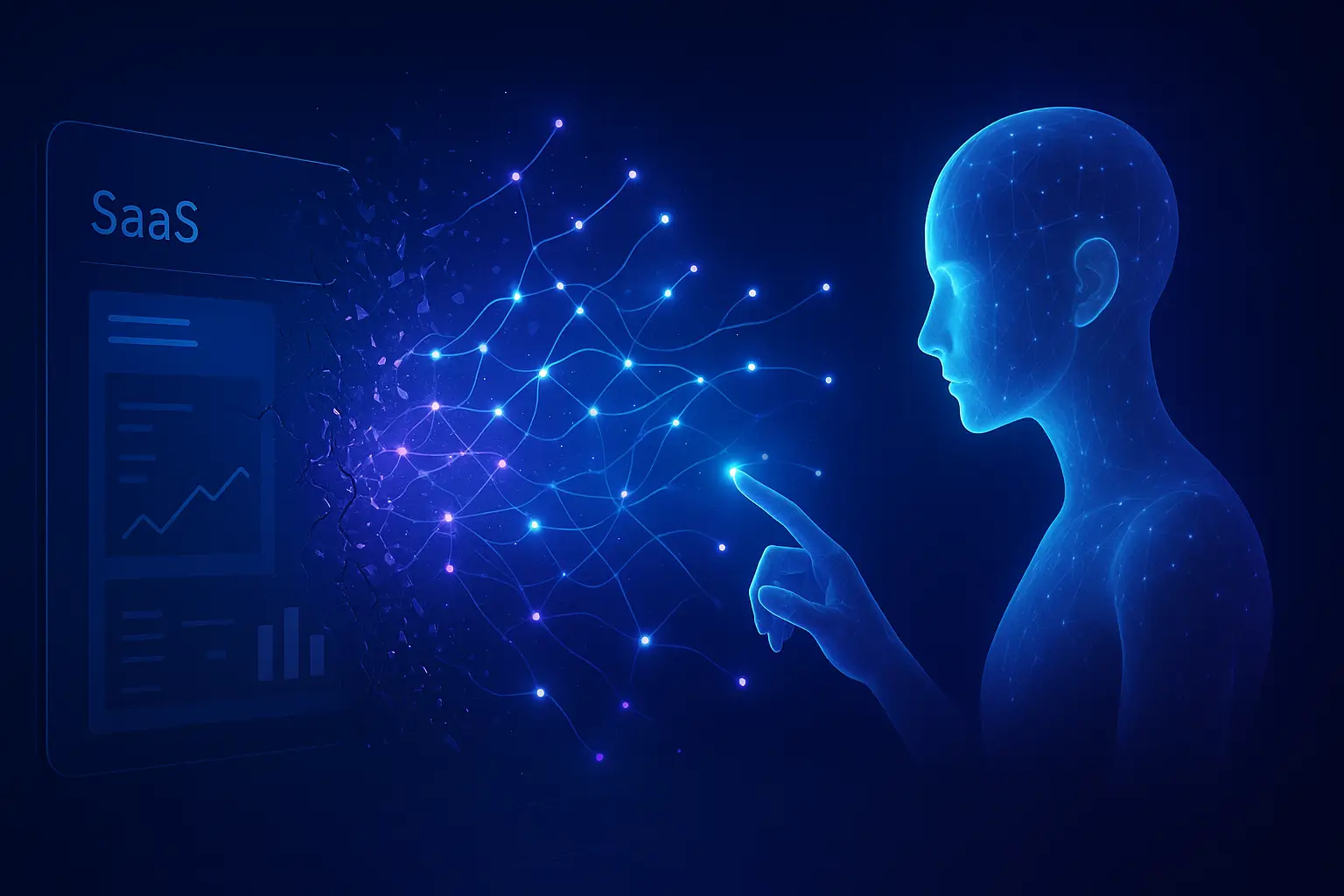
The world of Software-as-a-Service (SaaS) stands at the edge of a seismic shift, one driven by the exponential rise of artificial intelligence. More specifically, AI agents—autonomous programs powered by large language models (LLMs)—are poised to completely redefine how software platforms operate, deliver value, and interact with users. Tech leaders like Microsoft CEO Satya Nadella have predicted that the foundational structure of SaaS—essentially a database with business logic for creating, reading, updating, and deleting information—is on a collision course with a more intelligent, agentic future.
This transformation is not a distant concept; it’s happening now. The convergence of advanced AI with business applications is setting the stage for a new era where static interfaces and manual workflows become relics of the past. At DigitalOriginTech, our analysis indicates that by 2025, the market will see a profound evolution from AI-enhanced systems to entirely new, AI-native business models. This article explores this disruption, from the core anatomy of AI agents to the multi-agent ecosystems and specialized vertical agents that promise to outscale SaaS by an order of magnitude.
Table of Contents
The End of SaaS as We Know It: Why AI Agents Are the Next Revolution
For over two decades, SaaS has been the dominant model for software delivery, offering accessibility and scalability. However, its core—a user-driven, menu-based interaction with a database—is fundamentally passive. The user must know what to do, navigate complex interfaces, and manually execute tasks.
Agentic AI flips this model on its head. Instead of a user operating an app, an AI agent understands a goal and autonomously executes the entire workflow to achieve it. This paradigm shift moves the value from the application itself to the outcome the agent delivers. As predicted, this could collapse the traditional structure of many SaaS applications, as the focus shifts from providing tools to providing automated results. This is the core of the AI agents SaaS disruption: a move from software that serves users to software that acts for users.
What Are AI Agents? Deconstructing the New Digital Workforce
AI agents are sophisticated software programs, typically built on a foundation model, engineered to perform specific tasks autonomously. Unlike a simple chatbot, an agent is context-aware, goal-oriented, and capable of learning from its interactions. Think of them as hyper-specialized virtual team members who can automate complex processes, analyze data, and interact with other systems to achieve defined objectives.
The Core Anatomy of an AI Agent
An effective AI agent is more than just an LLM. Its architecture consists of several critical components working in concert:
-
Foundation Model: The brain of the agent, usually a Large Language Model (LLM) like GPT-4 or Gemini, or a smaller, more specialized model (SLM) optimized for a specific task.
-
System Prompt & Purpose: The agent’s constitution, defining its primary goal, constraints, and the expected format of its output.
-
Knowledge Base (Grounding): To ensure accuracy and relevance, agents are connected to external data sources, often using patterns like Retrieval-Augmented Generation (RAG) to pull in domain-specific information.
-
Toolkit: A set of specialized capabilities, such as the ability to call functions, search the internet, access databases, or interact with external APIs.
-
Orchestrator: The central nervous system that processes user inputs, coordinates the agent’s internal components (model, knowledge, tools), and delivers a coherent output.
-
User Experience (Optional): The interface through which a human interacts with the agent, though some agents may operate entirely in the background, communicating only with other agents.
From Autonomous Tasks to Strategic Goals
The true power of AI agents lies in their ability to move beyond simple task automation. For example, in a CRM platform, an agent could do more than just log a call. It could independently manage customer follow-ups based on sentiment analysis, schedule meetings by coordinating calendars, and generate predictive sales analytics to help teams prioritize leads—all with minimal human intervention.
The Power of Collaboration: From Single-Agent Systems to Multi-Agent Ecosystems
The initial wave of AI integration involved single-agent systems, but the next frontier is collaborative. Multi-agent systems represent a fundamental evolution in how complex problems are solved.
Single-Agent Systems: The Foundation
Single-agent systems are focused and task-specific, like an intelligent chatbot resolving a customer query or an agent summarizing a document. While powerful for isolated scenarios, they are limited in their ability to handle multifaceted, interconnected workflows and often require a human in the loop to provide continuous feedback and direction.
Multi-Agent Systems: The Future of Collaborative AI
Multi-agent systems involve a network of specialized AI agents working in harmony to achieve a goal that requires diverse expertise. This model emulates a human team, where different members contribute unique skills. In a business context, these systems can distribute complex tasks, allowing each agent to focus on a sub-problem, leading to a more robust and efficient outcome.
Consider a project management platform powered by a multi-agent system:
-
One agent could be the Planner, responsible for breaking down project goals into actionable tasks.
-
Another agent, the Risk Forecaster, could analyze project data to identify potential delays or budget overruns.
-
A third agent, the Resource Allocator, could manage team assignments and scheduling.
These agents would communicate, negotiate, and delegate amongst themselves to optimize the project’s execution, only escalating to a human for supervision or final approval when necessary.
Building the Future: Key Platforms and Tools for AI Agent Development
The explosion of AI agents is being fueled by an ecosystem of powerful platforms and frameworks that democratize their development. These tools provide the building blocks for creating, training, and deploying sophisticated agents.
Open-Source Frameworks Paving the Way
-
LangChain & Semantic Kernel: These are popular open-source SDKs (available for Python, C#, etc.) that provide a flexible middleware for chaining LLM calls, managing memory, and connecting to various tools and data sources. They are the go-to for developers wanting deep customization.
-
AutoGen: A Microsoft Research framework designed to simplify the creation of multi-agent conversational systems. It excels at orchestrating complex workflows where multiple agents collaborate and critique each other’s work.
-
AutoGPT: An early and influential open-source framework focused on creating fully autonomous, multi-agent systems that can tackle goals with minimal human input.
Low-Code/No-Code Platforms Democratizing AI
-
Microsoft Copilot Studio: Allows users with limited technical skills to create and customize AI assistants for Microsoft 365 and other platforms using a graphical interface and generative AI.
-
Azure AI Foundry: A comprehensive platform that includes an “assistant builder,” enabling businesses to construct and deploy enterprise-grade agents within the Azure cloud ecosystem.
Redefining Interaction: The Evolution of the Human-Agent Interface (HAI)
For AI agents to be truly effective, they must integrate seamlessly into human workflows. The design of the Human-Agent Interface (HAI) is critical for bridging the gap between advanced AI capabilities and user accessibility.
Beyond the Keyboard: Conversational and Proactive Interfaces
The traditional graphical user interface (GUI) with its menus and buttons will give way to more fluid, conversational interactions. Users will be able to issue commands in natural language, such as “Generate a quarterly performance report for the sales team and highlight the top three accounts.” The agent will not only execute the command but may also become proactive, anticipating needs and suggesting optimizations or alerting teams to emerging trends without being asked.
Personalized and Adaptive User Experiences
AI agents will tailor SaaS interfaces to individual users. Instead of a one-size-fits-all dashboard, the platform will dynamically adapt based on a user’s role, behavior, and preferences. A project manager might see a high-level Gantt chart, while a developer sees a detailed task list. Over time, the agent learns and suggests custom shortcuts or workflows, making the interface feel intuitive and uniquely personal.
The Role of Augmented Reality and Decentralized Access
The interface is also breaking free from the application window.
-
Augmented Reality (AR): For design or data visualization tools, an agent could overlay 3D models and charts onto a user’s physical environment, creating an immersive way to interact with complex information.
-
Decentralized Interfaces: Agents will allow users to access SaaS functionality from wherever they are working, such as a messaging platform like Microsoft Teams or Slack. A user could ask a question or trigger a workflow without ever leaving their conversation.
The Tectonic Shift: How AI Agents Will Fundamentally Disrupt the SaaS Market
The rise of agentic AI is more than an incremental improvement; it is a disruptive force creating new winners and losers.
Driving Unprecedented Operational Efficiency
By automating complex, end-to-end workflows, multi-agent systems will unlock new levels of productivity. They can handle routine tasks, allowing human employees to focus on high-level strategy, creativity, and decision-making. This shift from manual execution to strategic oversight is a core benefit of the agentic revolution.
Enabling Hyper-Personalization at Scale
AI agents’ ability to learn and adapt will enable SaaS platforms to deliver a unique, hyper-personalized experience for every single user. This goes beyond changing a dashboard layout; it means anticipating individual needs and proactively delivering solutions, creating a level of customer value that is impossible to achieve with traditional software.
Creating New “AI-as-a-Service” (AIaaS) Business Models
The most profound disruption may come from new business models. Instead of subscribing to a software platform, businesses may subscribe to specialized AI agents. This is particularly true for Vertical AI Agents—systems designed with deep, domain-specific knowledge for industries like healthcare, finance, or law. These agents come pre-trained on industry regulations and workflows, offering immediate value. Experts predict this specialized market could create hundreds of billion-dollar companies, far exceeding the scale of horizontal SaaS.
Conclusion: Are You Prepared for the Post-SaaS Era?
AI agents are not just another feature to be added to a product roadmap; they represent a fundamental reimagining of how software creates and delivers value. They are collaborators, amplifiers, and disruptors. As we move further into this new era, our team at DigitalOriginTech sees a clear divide emerging. Businesses that embrace this transformation by integrating multi-agent systems and rethinking their user interfaces will thrive. Those who cling to the traditional, passive SaaS paradigm risk becoming obsolete. The question is no longer if AI agents SaaS will cause a disruption, but how quickly and effectively organizations can adapt to lead the charge.
Recent Insights:

Top 10 WordPress Development Companies in 2026
Top 10 WordPress Development Companies in 2026 The evolution of WordPress from a simple blogging tool into a robust, enterprise-grade Digital Experience Platform (DXP) has been nothing short of revolutionary. As we navigate 2026, WordPress powers more than half of the...

Why Use Spring Boot? Top Benefits for Java Developers
Why Use Spring Boot? Top Benefits for Java Developers (2025)In the world of Java development, efficiency, speed, and scalability are paramount. Frameworks exist to provide structure and reduce boilerplate, allowing developers to focus on core...
Contact Us
Info@DigitalOriginTech.com
Get all your questions answered by our team.
F&Q
What is the main difference between a single-agent and a multi-agent AI system?
A single-agent system consists of one AI agent designed to perform specific, often isolated, tasks. A multi-agent system is a network of several specialized AI agents that collaborate, communicate, and delegate tasks among themselves to solve a more complex problem, much like a human team.
Will AI agents completely replace SaaS platforms?
It’s more likely that AI agents will fundamentally transform SaaS rather than replace it entirely. Many experts predict a hybrid future where SaaS platforms evolve into AI-first ecosystems, integrating agentic capabilities as a core part of their offering. However, standalone SaaS products that fail to adapt face a significant threat of being made obsolete by more efficient and autonomous agent-based solutions.
What are "Vertical AI Agents"?
Vertical AI agents are AI systems designed for a specific industry or “vertical,” such as healthcare, finance, or manufacturing. Unlike general-purpose AI, they are trained on domain-specific data, terminology, and workflows, allowing them to perform complex, specialized tasks with high accuracy and an understanding of industry context.
Do I need to be a coder to build an AI agent?
Not necessarily. While developers use powerful frameworks like LangChain and AutoGen, the rise of low-code/no-code platforms like Microsoft Copilot Studio and Azure AI Foundry is making it possible for non-technical users to build and configure their own AI agents using graphical interfaces and pre-built templates.
How does a human-agent interface (HAI) improve user experience?
A well-designed HAI improves user experience by making interactions with complex AI systems more intuitive, transparent, and trustworthy. Instead of navigating menus, users can communicate with natural language. The interface can also personalize itself to the user’s needs and even proactively offer assistance, reducing friction and cognitive load. For more on the principles of HAI, see the research from institutions like AAAI.